
How to do the flowers
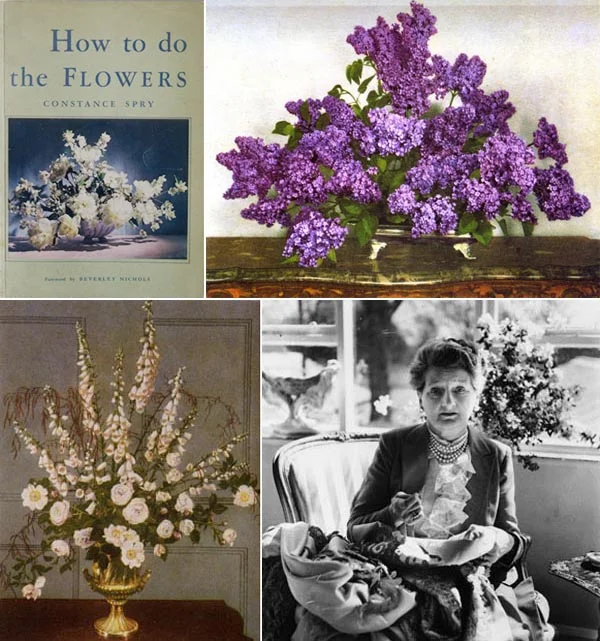
Long before Martha Stewart launched her empire and Nigella inspired a whole generation of cup cake baking would-be-domestic-goddesses, there was Constance Spry.
Although she is probably best known for her books on flower arranging, she also taught and wrote on cookery and other domestic arts and is credited by the Design Museum as having ‘democratised home-making in mid 20th century Britain’.
‘How to do the Flowers’ is the latest addition to my collection of vintage floristry books, rescued from a pile of junk in a charity shop in Narbeth on our recent trip to Wales. Often I use these more for visual inspiration than as reading material but just a few sentences in I was hooked and I read it cover to cover in a single sitting.
Published in 1952, it exhorts a generation of 1950s post war housewives to unleash their inner creativity by plucking wild flowers, seedheads, berries and weeds from hedgerows, wasteland and overgrown bomb sites in order to ‘beautify’ their home. Acknowledging that bone china was hard to come by ‘in between blitzes and bombs’, she encouraged women to ransack their attics and kitchen cupboards for whatever they could find in order to arrange flowers. There are frequent references to gravy boats and baking trays.
“At that time, flowers were the preserve of the wealthy, who could afford to buy cut flowers, and middle class families with large gardens. Constance taught her students that everyone’s lives could be enlivened by flowers, even in the poorest homes, and that all you needed was imagination, not money, to create a flower arrangement, which would be all the more satisfying if you made it yourself. ” (Design Museum)
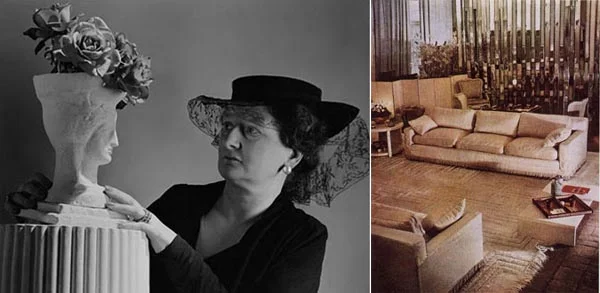
The celebrity florist of her day, she designed the flowers for Westminster Abbey for Queen Elizabeth’s coronation and also counted the Duchess of Windsor and the interior designer Syrie Maugham (credited with designing the first white room) amongst her clients.
Constance believed passionately in improving quality of life through simple pleasures, encouraging people to become “A millionaire for a few pence”. This became the title of an exhibition at the Design Museum in London in 2004 which was considered controversial in many quarters. Terence Conran described it as ‘high-society mimsiness’, and it ultimately led to the resignation of the museum’s chairman, the resolutely functionalist James Dyson, who considered the show unworthy.
Regarded as a quaintly anachronistic figure in her time, I think she would be quite at home in 2011. Her DIY creative approach feels very current. Despite her ladylike appearance, and the non-ironic, WI style instructional title of the book, Constance’s approach was very no nonense and down to earth and her writing is engaging and accessible. I can’t help thinking that I would have rather liked her.
Images: Constance Spry
